
Ideas for better growth
Refreshing Old Content for SEO
Chris Content · · 5 min read

Updating what you already published usually beats writing something new. How to find the pages worth refreshing, what to change, and how to measure the result.
Content strategy defaults to publishing more. For most sites with an existing archive, the higher return is in the pages already published: they have history, links, and proven relevance, and they are usually one revision away from performing meaningfully better.
Step 1: Find the candidates
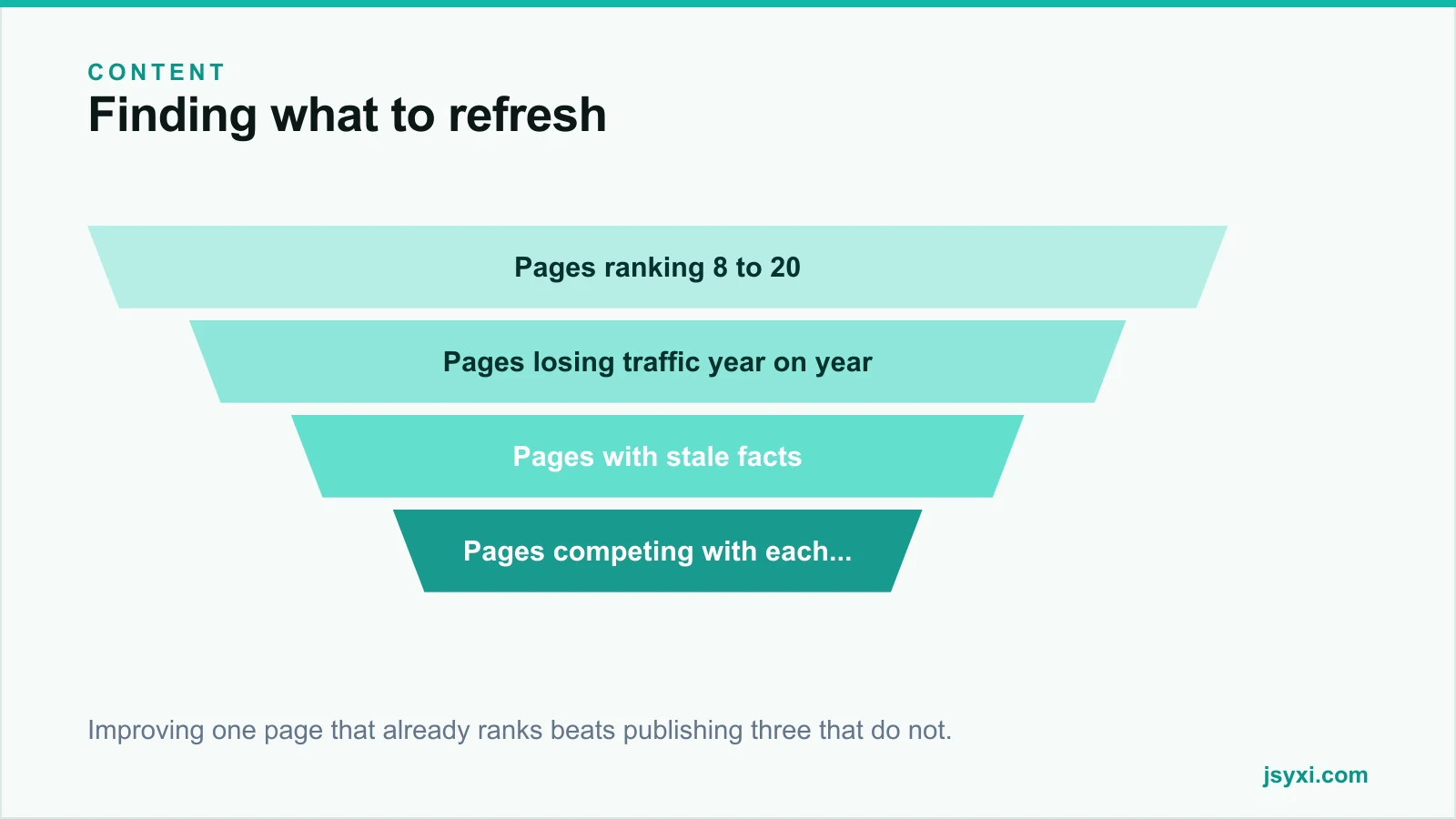
Four groups, in order of return:
Pages ranking between positions 8 and 20. The topic is proven relevant and the page already ranks. Moving from position 12 to position 5 changes the traffic substantially, and it is far easier than ranking a new page.
Pages losing traffic year on year. Compare the last 90 days with the same period a year earlier. A steady decline usually means the content has aged or competitors improved.
Pages with stale facts. Prices, dates, product links, screenshots, statistics, and any reference to "this year".
Pages competing with each other. Two articles targeting the same intent split links and rankings and neither wins - see keyword research.
Pull the first two lists from Search Console. It takes an afternoon and it is the highest-return content work available.
Step 2: Diagnose before rewriting
For each candidate, look at what the page actually receives:
- Which queries does it appear for?
- Does the page genuinely answer those queries, or only touch them?
- Are there queries it ranks for that it barely mentions? That is the gap.
- What does the current first page of results contain that yours does not?
- Has the intent shifted - is the search now answered by a different format?
Do not rewrite on instinct. The queries tell you what is missing.
Step 3: Make the changes that matter
In order of impact:
Cover the gaps. Add sections answering the queries the page ranks for but does not address. This is usually the single biggest lever.
Fix the title and description. A page with impressions but few clicks has a title problem, not a content problem. Rewrite it to match the searcher's phrasing and to promise what the page delivers.
Update every fact. Prices, dates, product names, links, screenshots, and statistics. One obviously outdated fact makes readers doubt everything else.
Improve the opening. Answer the question in the first two paragraphs rather than after a history of the industry.
Add an FAQ section. Cover the related questions people also ask, using a real FAQ accordion where it suits the page.
Fix the internal links. Link to newer relevant content, and add links to this page from the relevant hub - see internal linking.
Check speed and layout. Old pages often carry heavy images and legacy embeds.
Step 4: Merge competing pages
Where two pages target the same intent:
- Choose the stronger one - more links, better rankings, better URL
- Move the unique value from the weaker page into it
- Redirect the weaker URL permanently to the survivor
- Update internal links to point at the survivor directly
Merging two mediocre pages into one strong one is often the highest-return action in an entire content archive.
Step 5: Be honest about dates
- Update the modified date only when the content genuinely changed
- Do not change the published date to fake freshness - it is a pattern that gets noticed
- Show both dates where it helps the reader
- Reflect real changes in your structured data - see our schema guide
Rewriting an introduction and bumping the date is not a refresh; it is a claim you cannot support.
Step 6: Know when to delete instead
Not everything deserves saving:
- Content about a product or service you no longer offer
- Event pages with no ongoing value
- Thin pages that never ranked and never will
- Duplicates with nothing unique
Redirect them to the closest relevant page if one exists. If nothing is relevant, let them return 404 or 410. A smaller archive of pages that all earn their place is stronger than a large one padded with pages nobody reads.
Step 7: Measure the result
- Record position, impressions, clicks, and conversions before you change anything
- Change one page at a time so you can attribute the effect
- Allow four to eight weeks before judging
- Watch conversions, not only traffic - a page can gain visitors and lose customers
Step 8: Make it routine
- Review your top 20 pages quarterly
- Add a "last reviewed" note in your own records, not necessarily on the page
- Include content checks in your monthly maintenance routine
- Refresh before publishing new work when both compete for the same limited time
Common mistakes to avoid
- Bumping the date without changing anything. It is a hollow signal.
- Rewriting from scratch. You risk losing what already worked.
- Changing the URL unnecessarily. It discards accumulated value.
- Refreshing everything at once. You cannot attribute the result.
- Keeping every old page. Some should be merged or removed.
Frequently asked questions
How often should I update old blog posts?
Review your top 20 pages quarterly and refresh the ones with stale facts, declining traffic, or rankings between positions 8 and 20. Not every page needs an annual rewrite.
Does updating old content help SEO?
Yes, when the update genuinely improves coverage, accuracy, and clarity. Search engines respond to a better answer, not to a changed date.
Should I change the published date when I update a post?
Update the modified date; leave the original published date alone. Faking freshness by resetting the publish date is a recognisable pattern and it misleads readers.
Is it better to update old content or write new content?
For most sites with an existing archive, updating wins. A page already ranking on the second page needs far less work to reach the first than a new page needs to rank at all.
Next steps
Export your Search Console queries, filter to pages ranking between positions 8 and 20, and improve the top three by covering the queries they rank for but do not answer.
If you want this run as a programme, see our digital marketing and SEO service.