
Ideas for better growth
Keyword Research for Online Stores
Chris Content · · 5 min read

Find the searches that actually produce orders: intent over volume, category and product page mapping, long-tail opportunities, and what to ignore.
Keyword research for a store goes wrong in a predictable way: someone exports a list sorted by volume, picks the biggest terms, and writes pages that never rank and would not convert if they did.
The useful version starts with intent and with data you already own.
Start with your own data
Before opening any research tool, mine what your business already knows:
- Site search queries. What people typed into your own search box, especially the ones that returned nothing.
- Search Console queries. Terms you already appear for, including on page two, where small improvements pay quickly.
- Support and sales questions. The exact phrasing customers use.
- Product and category names customers use, which are often not your internal names.
- Marketplace search terms, if you also sell on one.
This data has an advantage no tool offers: it is your actual audience, using their actual words.
Understand the four intents
Every search sits in one of four buckets, and each needs a different page:
- Transactional - "buy cotton bedsheets online". Needs a category or product page.
- Commercial - "best cotton bedsheets for summer". Needs a comparison or buying guide.
- Informational - "how to care for cotton bedsheets". Needs an article.
- Navigational - your brand name. Needs your homepage and to be defended.
The most common mistake is pointing a blog post at a transactional query, or a category page at an informational one. Search the term and look at what already ranks - that is the format the search engine has decided satisfies the intent.
Expand deliberately
Once you have seed terms, expand them:
- Autocomplete suggestions and related searches
- "People also ask" questions
- Competitor category and filter names
- Attribute modifiers: size, material, colour, use case, price band, season
- Problem-led phrasing: "bedsheet that does not pill"
Long-tail terms with modest volume are usually where a small store wins. They are less competitive, more specific, and convert far better because the searcher has already narrowed their decision.
Group by intent, not by string similarity
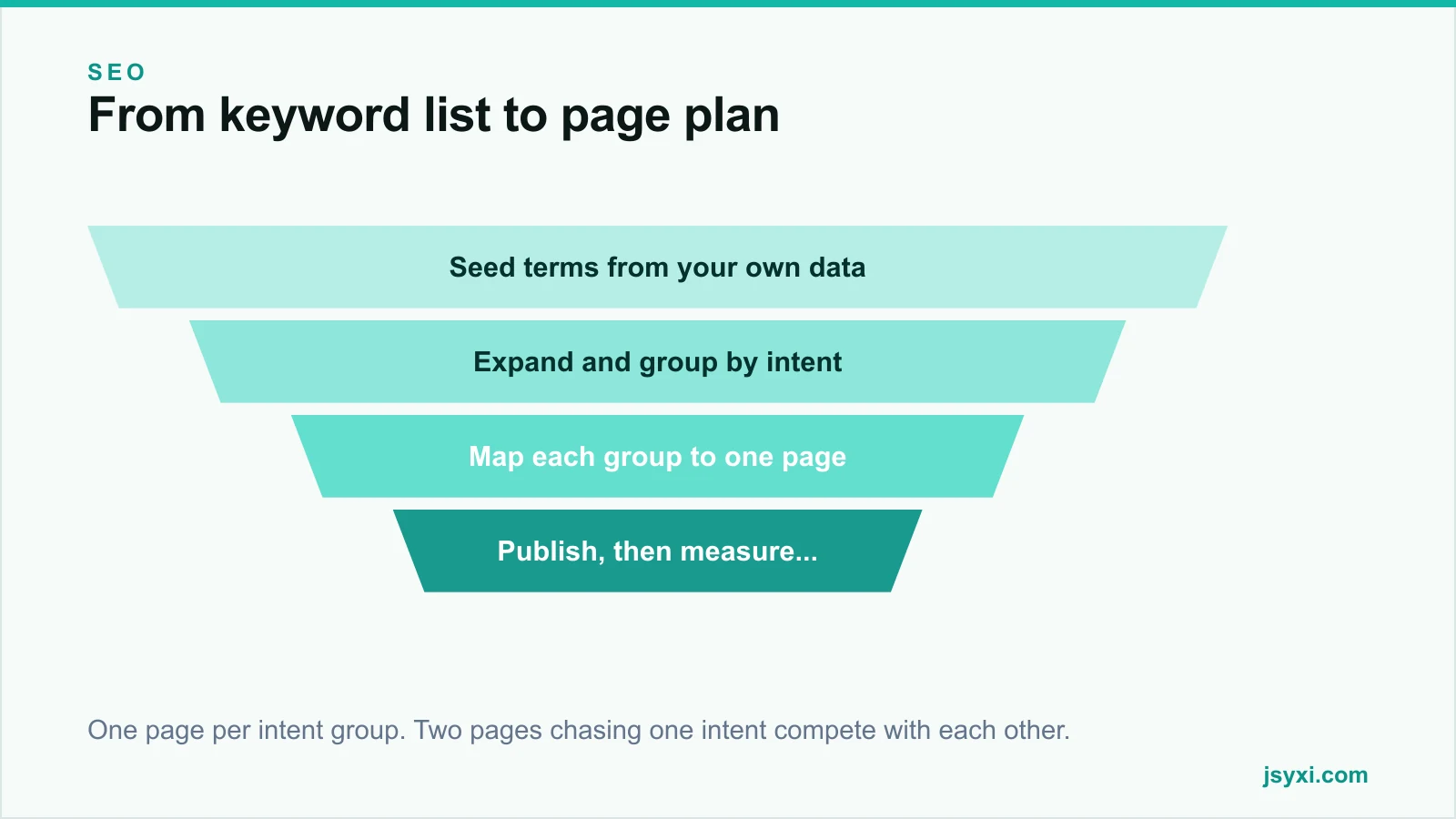
Cluster your expanded list so that every term that would be satisfied by the same page sits together. Two terms belong in the same group if the same page would be a good answer to both.
Then assign exactly one page per group. If two of your pages target the same intent, they compete with each other, split your internal links, and neither ranks well.
Map groups to page types
- Broad category terms to category pages
- Attribute-qualified terms to filtered category pages, but only if that filtered view is a real, indexable, linkable page with its own content
- Specific product terms to product pages
- Comparison and "best" terms to buying guides
- How-to and problem terms to articles
Filtered views deserve caution. Making every filter combination indexable creates thousands of thin pages. Choose the handful of filters with genuine demand, give them real content, and canonicalise the rest.
Judge opportunity, not volume
For each group, weigh:
- Relevance. Would this searcher buy from you? A high-volume term you cannot serve is worthless.
- Difficulty. Who ranks now? If the first page is entirely national marketplaces and brands, a small store will not displace them quickly.
- Business value. Margin and repeat potential, not just conversion rate.
- Effort. A new page, or a rewrite of one that already ranks on page two?
The best first projects are usually terms where you already rank between positions eight and twenty. The page exists, the topic is proven relevant, and modest improvement moves it into visible territory.
Write the page for the searcher
Once mapped, the page has to actually satisfy the query:
- Title and H1 that use the searcher's phrasing naturally
- The answer or product visible without scrolling
- The attributes the query implies, covered explicitly
- Related questions answered on the page, ideally with an FAQ accordion
- Internal links from the relevant hub - see our internal linking guide
Do not repeat the keyword mechanically. Search engines match meaning, and stuffed copy reads badly to the person you are trying to sell to.
Measure and iterate
After publishing, Search Console tells you what actually happened:
- Which queries the page appears for, including ones you did not target
- Average position and click-through rate
- Impressions without clicks, which usually means a title problem
- Queries where you rank but the page does not address them - a content gap
The queries you did not plan for are often the most valuable finding. They tell you how customers actually describe the problem.
Common mistakes to avoid
- Sorting by volume and picking the top rows. Volume without relevance is traffic that never buys.
- Two pages targeting the same intent. They compete and both underperform.
- Ignoring your own site search. It is the cheapest, most accurate source you have.
- Chasing head terms dominated by marketplaces. Win the specific queries first.
- Never re-checking. Search behaviour shifts by season and by year.
Frequently asked questions
How do I find keywords without a paid tool?
Use Search Console for terms you already appear for, your own site search logs, autocomplete and related searches, "people also ask" questions, and competitor category names. That combination covers most of what a small store needs.
Should each product page target a keyword?
Each product page should target the way customers describe that product, including the attributes they search by. Do not force a keyword that does not match the item; the page will attract the wrong visitors.
How many keywords should one page target?
One intent group, which may contain many phrasings of the same need. Trying to satisfy two different intents on one page usually satisfies neither.
Is search volume important?
Less than relevance. A term with modest volume that describes exactly what you sell will produce more orders than a high-volume term where you are one of forty results and the searcher wants something else.
Next steps
Export your site search queries and your Search Console terms in positions eight to twenty, group them by intent, and improve the pages that already rank before building new ones.
If you want the research and the page plan done for you, see our digital marketing and SEO service.