
Ideas for better growth
A Simple Lead Qualification and Scoring Framework
Chris Content · · 4 min read
Stop treating every enquiry the same. A lightweight scoring framework a small team can run without a data science project or an enterprise CRM.
Most small sales teams treat every enquiry identically, work them in the order they arrived, and run out of time before reaching the ones that would have closed. Qualification is simply deciding, quickly and consistently, which enquiries deserve the next hour.
It does not require an enterprise platform. It requires agreement on four questions and the discipline to answer them.
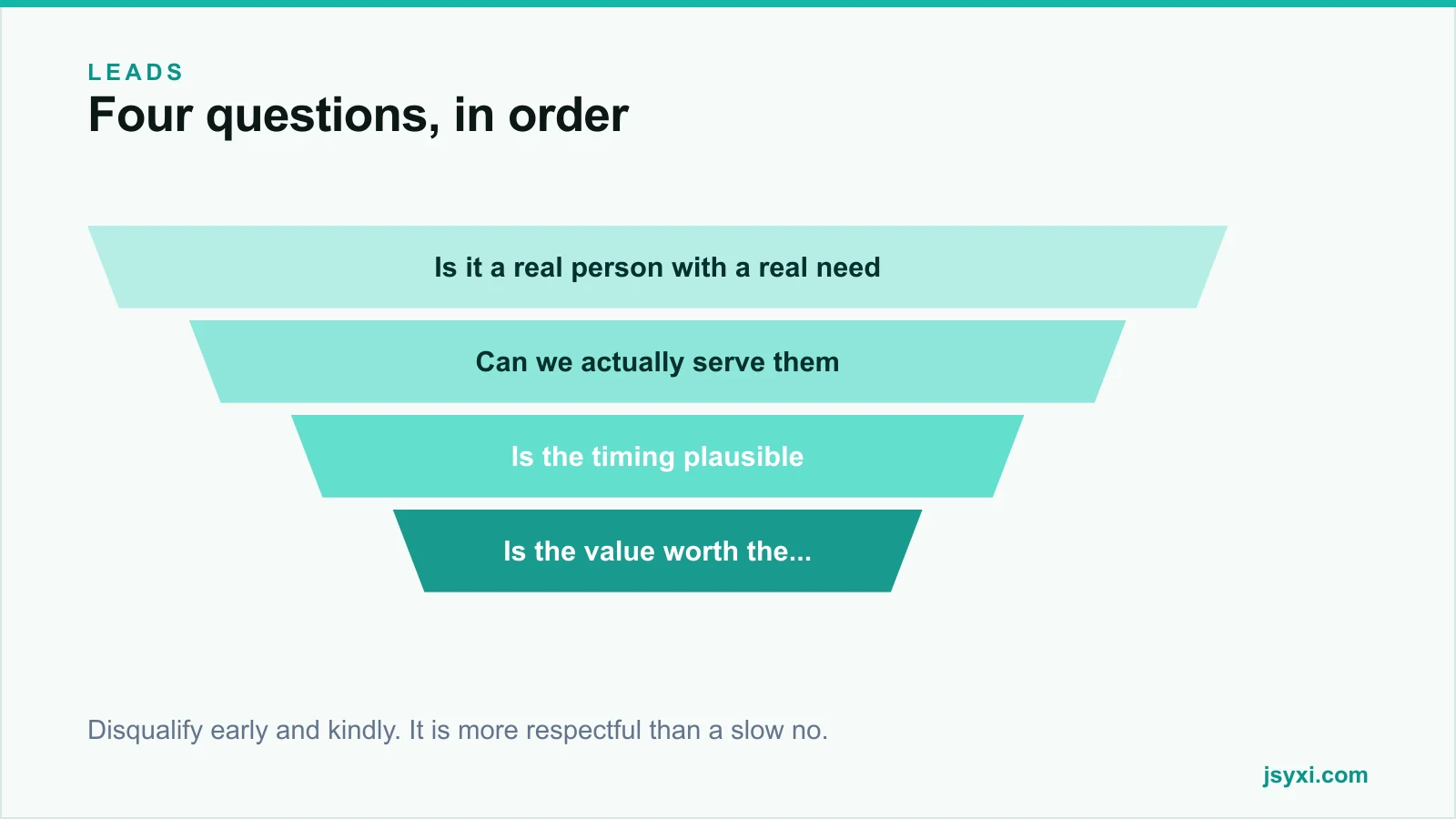
The four questions
Ask them in this order, because each one is cheaper to answer than the next:
- Is this a real person with a real need? Filters spam, students, competitors, and vendors.
- Can we actually serve them? Geography, category, capacity, technical fit, regulatory constraints.
- Is the timing plausible? Now, this quarter, or "someday".
- Is the value worth the effort? Budget band against your cost to serve.
Stopping at the first "no" saves the most time. A lead that fails question two should never reach a pricing conversation.
Build a score you can explain
Complex scoring models fail in small teams because nobody trusts a number they cannot explain. Build something simple enough to compute in your head.
Score two dimensions separately:
Fit - how well they match a good customer:
- Right category or service need
- Serviceable location
- Plausible size or order value
- No disqualifying constraint
Intent - how ready they are:
- Requested a quote or demo rather than downloading a guide
- Gave a specific requirement rather than a vague one
- Provided a phone number
- Visited pricing or product pages before enquiring
- Mentioned a timeline
Give each signal a small weight, and treat the two dimensions as a grid rather than a single total. High fit with low intent needs nurturing. High intent with low fit needs a fast, polite no. High on both goes to the top of the queue today.
Capture the signals at the source
You cannot score what you did not capture. Make sure every submission carries:
- Source page, so you know which content produced it
- Campaign or referrer
- Timestamp, in your working timezone
- The visitor's own description of what they need
- Any qualifier the form asked for
- Calculator or configurator inputs, if they used one
A Form Builder widget that writes into your lead queue with the source attached makes this automatic. See wiring your website into your CRM.
Define the stages plainly
Agree on a small number of stages with objective entry criteria:
- New - received, not yet contacted
- Contacted - a genuine attempt made, logged
- Qualified - passed the four questions
- Proposal - a specific offer made
- Won / Lost - with a reason recorded
Five stages are enough for most small businesses. What matters far more than the number is that everyone agrees what moves a lead between them.
Record loss reasons
The most valuable data a small sales process produces is why deals were lost. Use a short fixed list:
- Price
- Timing
- Chose a competitor
- Not serviceable
- No response
- Not a real opportunity
Six months of loss reasons will tell you more about your website, pricing, and positioning than any analytics dashboard. If "not serviceable" dominates, your marketing is attracting the wrong people. If "no response" dominates, your follow-up is too slow - see speed to lead.
Disqualify early and kindly
Saying no quickly is a service to everyone:
- Reply the same day
- Explain briefly why you are not the right fit
- Refer them elsewhere if you can
- Keep the door open for a future need
A fast, honest no earns more referrals than a slow drift into silence.
Review the model quarterly
A scoring model built on assumptions must be checked against outcomes:
- Which signals actually correlated with closed deals?
- Which high-scoring leads went nowhere?
- Which low-scoring leads closed, and what did the model miss?
- Has the mix of enquiry sources shifted?
Adjust weights based on what closed, not on what feels intuitive.
Common mistakes to avoid
- Scoring on engagement alone. Opening emails is not buying intent.
- A model nobody can explain. If sales does not trust it, they ignore it.
- No disqualification path. Everything stays "open" forever and the pipeline becomes meaningless.
- Never recording loss reasons. You lose the only feedback loop you have.
- Treating a score as a decision. It is a priority hint, not a verdict.
Frequently asked questions
Do I need a CRM to score leads?
No. A shared spreadsheet with fit, intent, stage, and loss reason works for a small team. A CRM helps once volume or the number of people involved makes manual tracking unreliable.
What is the difference between fit and intent?
Fit is whether they would be a good customer; intent is how ready they are to buy. A perfect-fit lead with no urgency needs nurturing; a highly motivated lead you cannot serve needs a fast, polite decline.
How many lead stages should we have?
Around five for a small business: new, contacted, qualified, proposal, and closed with a reason. What matters is that everyone agrees on the objective criteria for moving between them.
Should I disqualify leads that are not ready to buy?
Do not delete them - move them to a nurture path with a review date. Disqualify only leads you genuinely cannot serve, and tell them so quickly.
Next steps
Write down your four qualification questions, agree the five stages with whoever handles enquiries, and start recording a loss reason on every closed lead. Review after one quarter.
Start free and capture the source and inputs on every enquiry you receive.