
Ideas for better growth
Speed to Lead: Why Response Time Decides Deals
Chris Content · · 4 min read
The gap between an enquiry and your first reply predicts conversion better than almost anything else. How to measure it and how to close it without hiring.
Sales teams spend enormous effort on messaging and almost none on response time, even though the gap between an enquiry arriving and the first human reply is one of the strongest predictors of whether it converts.
The mechanism is simple. A person enquiring is usually enquiring in several places. The first credible response frames the decision, and everyone else is compared against it.
Measure the number you actually have
Most teams believe their response time is better than it is, because they measure the wrong thing.
Measure first human response time: enquiry received to a real person's reply. Not the automated acknowledgement. Not the average of the cases someone remembered to log.
Then look at:
- The median and the worst decile, because averages hide disasters
- Response time by channel - forms, chat, phone, email
- Response time by hour and day, which exposes weekend and evening gaps
- The proportion never answered at all
That last number is usually the shock. In most small businesses a meaningful share of enquiries are never answered by anyone.
Fix the routing first
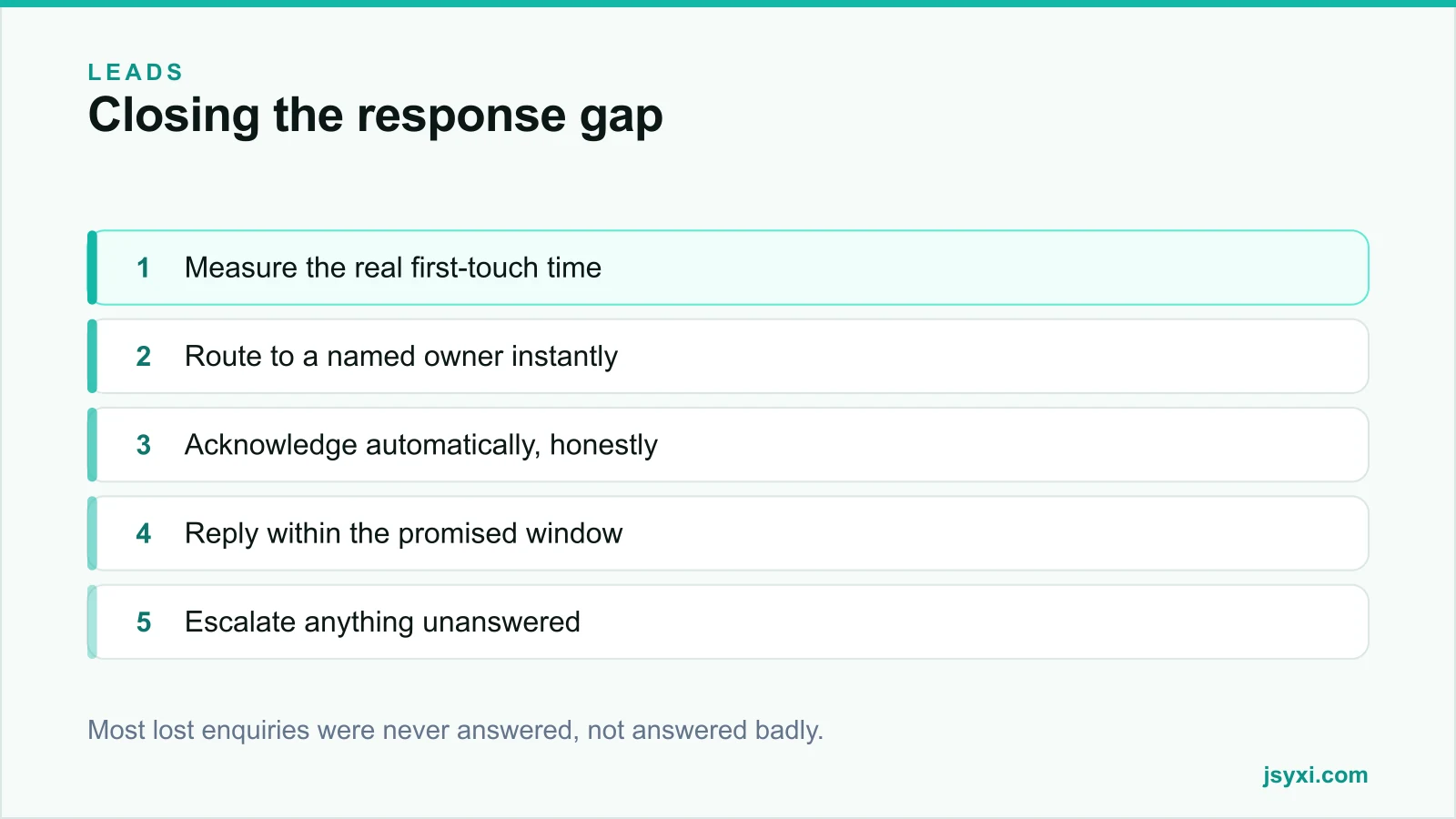
Slow responses are usually a routing problem, not an effort problem. Enquiries land in a shared inbox where everyone assumes someone else has it.
- Assign an owner automatically at the moment of arrival
- Notify that person on a channel they actually watch
- Make the owner visible to the team
- Escalate automatically if there is no first touch within a defined window
- Cover holidays and sick days explicitly, not implicitly
A named owner with an escalation rule fixes more than any amount of encouragement.
Acknowledge immediately, honestly
An instant automated acknowledgement is not a response, but it buys you time if it is honest:
- Confirm what was received
- State when a human will reply, specifically
- Say who will reply, and on which channel
- Give an urgent alternative - a phone number or WhatsApp
- Do not pretend to be a person
"We have your quote request. Rahul will call you before 6 PM today." is a genuine holding message. "Thank you for contacting us" is not.
Reduce the work of the first reply
Speed comes from removing work, not from working faster:
- Capture context on the form. The page, the product, and the calculator inputs mean the first reply can be specific.
- Prepare templates for the five most common enquiry types, with room to personalise.
- Pre-qualify with one form field so obvious mismatches are handled quickly - see our qualification framework.
- Let the customer choose the channel. Some will answer WhatsApp in seconds and never open an email.
Cover the hours you actually get enquiries
Look at when enquiries arrive, not when you work. Many businesses receive a large share of enquiries in the evening and at weekends, then respond on the next working morning.
Options that do not require a night shift:
- Publish honest response hours with a Business Hours widget, so expectations are set
- Offer self-service that works around the clock - a price calculator, a FAQ accordion, or booking
- Stagger one person's hours to cover the peak
- Use an out-of-hours acknowledgement with a specific next-morning commitment
Being honest about a slower window is far better than silence.
Follow up more than once
The first reply is not the only failure point. Most enquiries need several attempts:
- Try again on a different channel if the first gets no answer
- Space attempts sensibly over a couple of weeks
- Stop at a defined point and record the outcome
- Never leave a lead in limbo without a decision
"No response" is one of the most common loss reasons in small businesses, and it usually means one attempt was made.
Set a standard and hold to it
Agree a target that fits your business - many teams aim for a first human reply within an hour during working hours - then:
- Publish it on the form, so customers know what to expect
- Report on it weekly by owner
- Investigate the worst cases, not the average
- Treat a missed response like a missed delivery
Common mistakes to avoid
- Counting the auto-reply as the response. It measures nothing.
- A shared inbox with no owner. Everyone assumes someone else has it.
- Promising a response time you cannot meet. Worse than promising nothing.
- One follow-up attempt. Most enquiries need several.
- Reporting the average only. The worst cases are where the losses are.
Frequently asked questions
How fast should I respond to a web enquiry?
Within the hour during working hours is a realistic target for most small businesses, and faster is measurably better. What matters most is meeting the promise you publish, and never leaving an enquiry unanswered.
Does an automated reply count as a response?
No. It sets expectations and buys time, which is valuable, but the conversion effect comes from a human reply. Measure the first human response separately.
What should I do about enquiries that arrive at night?
Acknowledge automatically with a specific commitment for the morning, publish honest response hours, and offer self-service that works around the clock. Do not leave the message unacknowledged until the next working day.
How many times should I follow up?
Three to five attempts across a couple of weeks, varying the channel, then close the lead with a recorded reason. One attempt is the most common cause of "no response" losses.
Next steps
Measure your real first human response time for the last month, including the enquiries nobody answered. Then assign automatic ownership and an escalation rule before changing anything else.
Start free and capture every enquiry with its context attached.