
Ideas for better growth
How to Choose an Ecommerce Platform
Chris Content · · 5 min read
Hosted, open-source, or marketplace-first? A decision framework covering total cost, payment and logistics fit, migration risk, and what actually locks you in.
Platform choice is usually made on demo quality and monthly price, then regretted eighteen months later over transaction fees, a payment gateway that does not fit, or a catalogue structure that cannot express what you sell.
This is the order the decision is better made in.
Step 1: Write down your actual requirements
Not features - requirements. Specifically:
- Catalogue shape. How many products, how many variants each, do you need bundles, made-to-order, or subscriptions?
- Payments. Which methods do your customers use? UPI, cards, net banking, wallets, cash on delivery, EMI?
- Tax. Does the platform handle your GST requirements, including invoices in the required format?
- Logistics. Which couriers do you use, and does the platform integrate with them or your aggregator?
- Channels. Are you also selling on marketplaces or social, and does inventory need to stay in sync?
- Volume. Orders per month now, and a realistic figure in two years.
- Team. Who will run this day to day, and what can they do without a developer?
Mark each item must-have or nice-to-have. Most platform regret comes from a must-have that was assumed rather than checked.
Step 2: Understand the three broad options
Hosted platforms. You rent the software; the vendor handles hosting, security, and updates. Fastest to launch, predictable to run, least flexible at the edges. Costs rise with apps and transaction fees.
Open-source, self-hosted. You control everything and pay for hosting, maintenance, security patching, and development. Cheapest in licence terms, most expensive in attention. Sensible when you have technical capacity or genuinely unusual requirements.
Marketplace-first. You sell primarily on established marketplaces with a light site of your own. Fast access to demand, weak ownership of the customer relationship, and commission on every order.
Many Indian businesses end up with a combination: a hosted own-brand store plus marketplace channels. If that is you, inventory synchronisation is a must-have, not a nice-to-have.
Step 3: Calculate total cost, not the monthly price
Build a three-year figure for each option:
- Subscription or hosting
- Transaction fees charged by the platform, on top of gateway fees
- Payment gateway charges
- Apps or extensions you will actually need - reviews, shipping, marketing
- Theme or design work
- Developer time for setup and ongoing changes
- Migration cost, both in and eventually out
App and transaction costs are where hosted platforms surprise people. Four apps at a few thousand rupees a month each can exceed the platform subscription - see our app bloat audit.
Step 4: Test the things that actually break
Demos show the happy path. Test the awkward parts with real data:
- Import a realistic sample of your catalogue, including your most complex product
- Place a real order end to end, including a failed payment and a retry
- Generate a compliant tax invoice
- Process a return and a partial refund
- Check what a staff member can change without a developer
- Test the admin on a phone, since that is where small teams work
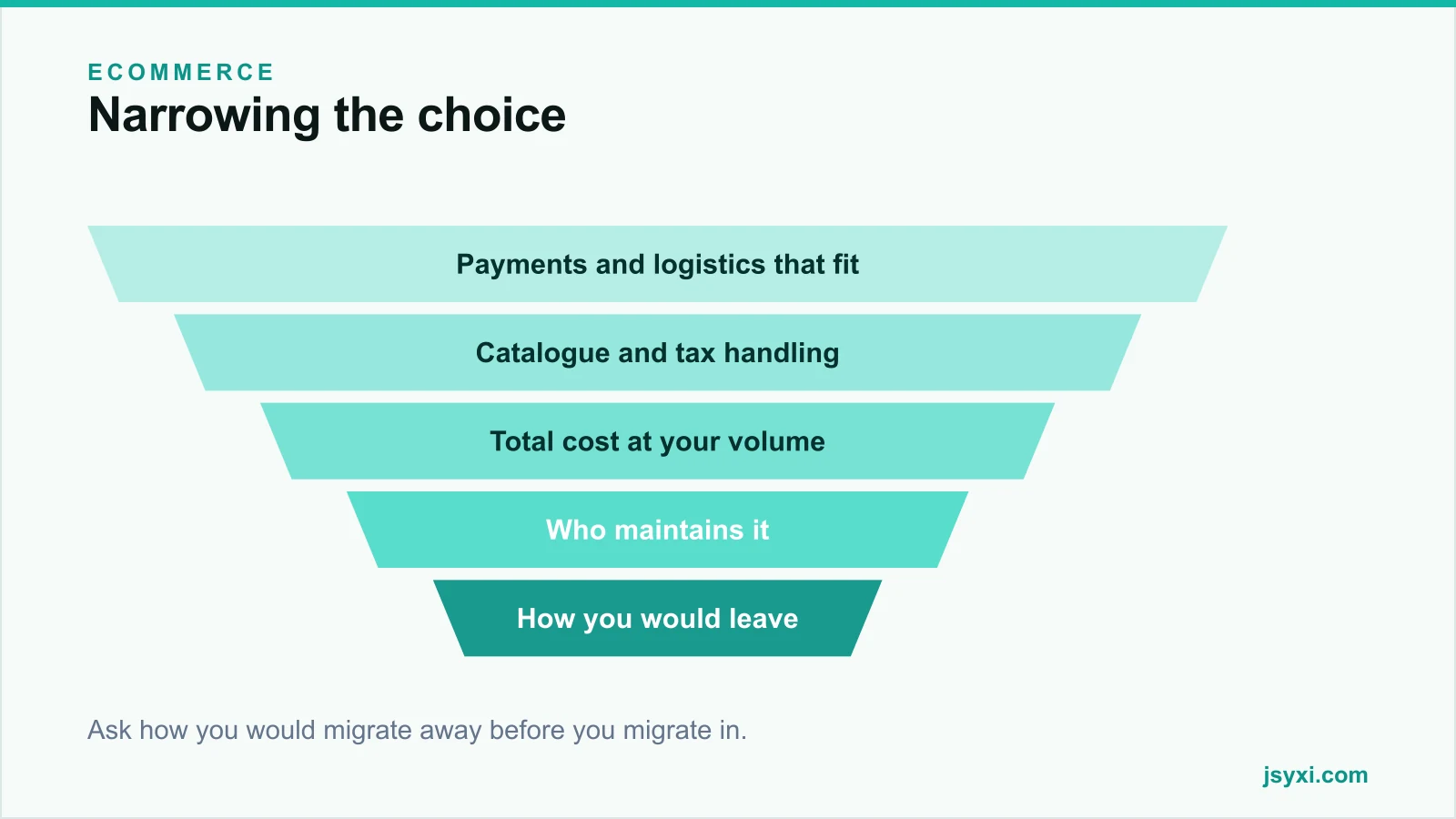
Step 5: Ask how you would leave
Before committing, establish the exit:
- Can you export products, customers, and orders in a usable format?
- Do you keep your customer data, including email consent status?
- Who owns the domain and the store account? It must be your business - see choosing a development agency
- Are URLs structured so they could be redirected after a migration?
- Is your content portable, or locked into proprietary page builders?
A platform you cannot leave will eventually charge you what it likes.
Step 6: Weigh the practical constraints
- Performance. Test a demo store on a mid-range phone; some themes are extremely heavy - see page speed.
- SEO control. Can you set titles, descriptions, canonicals, and redirects? Can you control the URL structure?
- Content. Is there a usable blog or content system, or will you bolt one on?
- Support. What is the response time when checkout breaks on a Sunday?
- Ecosystem. Is there a local developer pool who know this platform?
Step 7: Decide, then commit
Platform switching is expensive and disruptive. Once the analysis is done:
- Choose the option that meets your must-haves at a total cost you can sustain
- Plan the launch properly - see the website launch checklist
- Map every existing URL to its new equivalent before you migrate
- Give it at least a year before reconsidering
Common mistakes to avoid
- Choosing on monthly price. Apps and transaction fees dominate the real cost.
- Assuming payment support. Verify your specific methods with your specific gateway.
- Not testing your hardest product. Complex variants break platforms quietly.
- No exit plan. Data you cannot export is leverage against you.
- Migrating without a redirect map. It discards years of search history.
Frequently asked questions
What is the best ecommerce platform for a small business in India?
There is no single answer - it depends on catalogue complexity, the payment methods your customers use, GST invoicing needs, courier integrations, and who maintains the site. Score the shortlist against your must-haves rather than a feature list.
Is a hosted platform or open-source better?
Hosted is usually right when you lack technical capacity: faster to launch and someone else handles security and updates. Open-source suits teams with development resources or genuinely unusual requirements.
How much does an ecommerce platform really cost?
Add subscription, platform transaction fees, gateway charges, essential apps, theme work, and developer time over three years. Apps and transaction fees frequently exceed the headline subscription.
How hard is it to change platforms later?
Expensive and disruptive: catalogue and customer migration, a full redirect map, design rebuild, and integration rework. Check the export path before you commit, not after.
Next steps
Write your must-have list first, then test each shortlisted platform with your most complex product and a full order including a failed payment. Decide on total three-year cost, not the monthly price.
If you would rather have it scoped and built, see our ecommerce development service.