Ideas for better growth
Reduce Cart Abandonment Without Discounting
Chris Content · · 5 min read
Most abandoned carts are caused by surprises, not price. Fix delivery clarity, payment friction, and trust gaps before you start giving away margin.
The standard response to abandoned carts is a discount code. It works, in the sense that some people come back, and it also trains customers to abandon deliberately and teaches your margin to shrink.
Most abandonment is not a price objection. It is a surprise, a friction, or a doubt. Fix those first.
Diagnose before you treat
Before changing anything, find out where people are actually leaving:
- Cart view to checkout start
- Checkout start to address complete
- Address to payment
- Payment attempt to success
A drop between address and payment is a shipping-cost problem. A drop at payment attempt is a payment-method or failure-handling problem. A drop at cart view is usually a total-cost surprise. The remedy is different in each case.
Also read your own data qualitatively: failed payment logs, support messages, and the questions your WhatsApp queue receives at checkout time.
Fix 1: Kill the delivery surprise
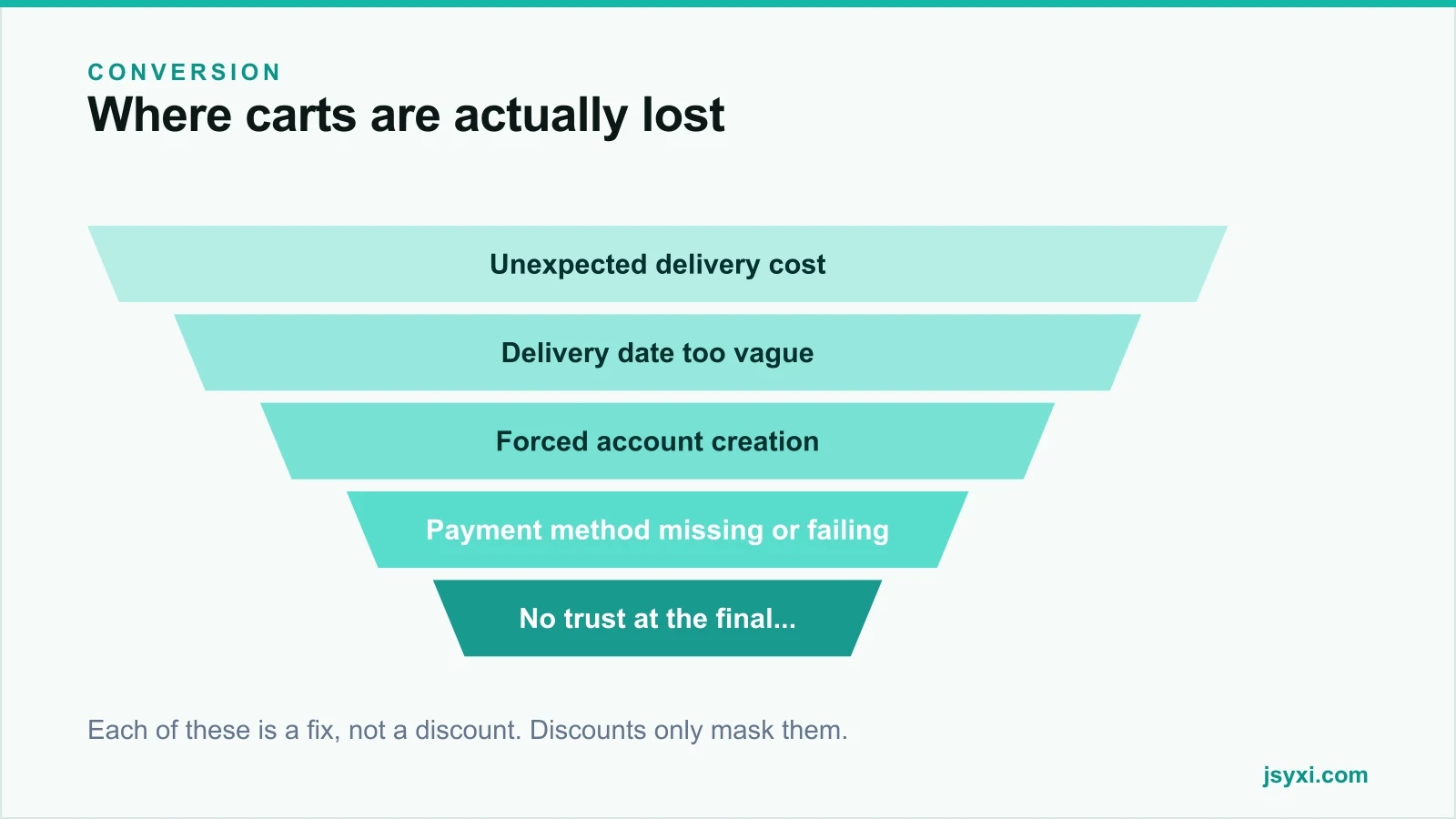
The single largest cause of abandonment in most stores is a shipping cost that appears late.
- Show delivery cost on the product page, not at the final step
- If free delivery has a threshold, show progress toward it in the cart
- Give an estimated delivery date, not "3 to 7 working days"
- Let buyers check serviceability by PIN code before adding to cart
- Show cash-on-delivery availability and any fee, up front
If your delivery cost is genuinely high, saying so early loses the sale earlier and cheaper than losing it at payment.
Fix 2: Remove forced account creation
Requiring an account before purchase is one of the highest-friction decisions a store can make. Offer guest checkout and invite account creation after the order is placed, when the customer has a reason to want order tracking.
If you need the account for loyalty or subscriptions, make it a one-tap creation from the order confirmation, not a prerequisite.
Fix 3: Reduce the form to what you need
Checkout forms accumulate fields nobody uses:
- Ask for one contact route, not three
- Auto-fill city and state from the PIN code
- Do not ask for a company name on a consumer store
- Use correct input types so the right keyboard appears
- Support browser autofill with standard field names
- Never clear the form on a validation error
Our guide on mobile checkout UX covers the field-by-field detail.
Fix 4: Get payment right
Payment is where intent turns into revenue or evaporates:
- Offer the methods your customers actually use, including UPI, cards, net banking, wallets, and cash on delivery where relevant
- Show the available methods before the final step, so nobody discovers theirs is missing at the end
- Handle failures gracefully: keep the cart, explain what happened, and offer a retry with a different method
- Do not clear the address when a payment fails
- Confirm success immediately and unambiguously
A large share of "abandonment" in some markets is actually payment failure that the store never surfaces as a retry.
Fix 5: Close the trust gap at the last step
The final step is where doubt peaks:
- Show the return policy in one line, near the pay button
- Show a support route - phone, WhatsApp, or chat - so a stuck buyer asks instead of leaving
- Show security and payment badges that are real
- Repeat the delivery date so it is not a surprise
- Keep the order summary visible, with the itemised total
See trust signals for online stores for what actually reassures and what is noise.
Fix 6: Remove distractions from the cart and checkout
Every link in checkout is an exit:
- No navigation menu inside the checkout flow
- No social feed, no blog links, no chat widget that covers the pay button
- No coupon field so prominent that it sends everyone hunting for a code
- No last-minute upsell that blocks the flow
If you must offer a coupon field, keep it small and collapsed. A prominent empty box tells buyers a discount exists and sends them to a coupon site.
Only then, recover
Once the structural problems are fixed, recovery is worth doing:
- Send the first reminder within a few hours, while the intent is warm
- Lead with the items and the delivery promise, not a discount
- Offer help before offering money: "Was something unclear about delivery?"
- Keep it to two messages
- Use a discount only for the second message, and only if margin allows
An honest countdown on a genuinely time-limited offer is fine. A fake timer that resets is not - see honest urgency.
Common mistakes to avoid
- Discounting first. It hides the real problem and trains abandonment.
- Hiding costs until the last step. The surprise is the abandonment.
- Treating payment failure as abandonment. Surface it and offer a retry.
- A prominent coupon box. It creates the very hunt that loses the sale.
- No recovery at all. Even one honest reminder recovers a meaningful share.
Frequently asked questions
What is a normal cart abandonment rate?
Published averages sit high across the industry, but the number matters less than the trend for your own store and the step where the drop happens. Track your funnel by step and compare against yourself.
Should I send a discount in the abandoned cart email?
Not in the first one. Lead with the items and the delivery promise, and offer help. Save any discount for a later message, and only if your margin supports it - otherwise you teach customers to abandon on purpose.
Does adding trust badges reduce abandonment?
Real, relevant ones can - a genuine payment security indicator, a clear return policy, a visible support route. Generic badges that link nowhere add clutter without adding reassurance.
Is guest checkout worth it?
Almost always. Forced account creation is a well-documented abandonment cause. Offer guest checkout and invite account creation after the order, when tracking gives the customer a reason to say yes.
Next steps
Measure your funnel step by step, find the largest single drop, and fix its cause before touching price. Start with delivery transparency on the product page - it is usually the cheapest win available.
Start free and close the gaps your checkout is leaking through.