
Ideas for better growth
How to Set a Free Shipping Threshold
Chris Content · · 5 min read

Free shipping thresholds lift average order value when the number is right and destroy margin when it is not. How to calculate, display, and test yours.
Free shipping is the most consistently effective offer in online retail, and the most consistently mispriced. Set the threshold too low and you give away margin on orders that would have converted anyway. Set it too high and you have simply advertised a charge nobody avoids.
This guide covers how to choose the number, how to display it, and how to test whether it worked.
Step 1: Know your real delivery cost
Start with the number you actually pay, per order, not per shipment quote:
- Courier charge by weight band and zone
- Packaging materials
- Handling time, costed honestly
- Return shipping, averaged across the category's return rate
- Cash-on-delivery fees and the cost of RTO where it applies
Return-to-origin costs are the most commonly forgotten. If a category returns at a meaningful rate and you pay both legs, your true delivery cost per successful order is much higher than the outbound quote.
Step 2: Plot the order value distribution
Export your last few months of orders and look at the distribution, not the average. The average is distorted by a few large orders and will lead you to a threshold most customers cannot reach.
Find:
- The median order value
- The most common basket size, by count
- The shape of the tail above the median
- How many single-item orders you get, and at what value
Most stores have a dense cluster of orders just above the price of one popular item. That cluster is what you are trying to move.
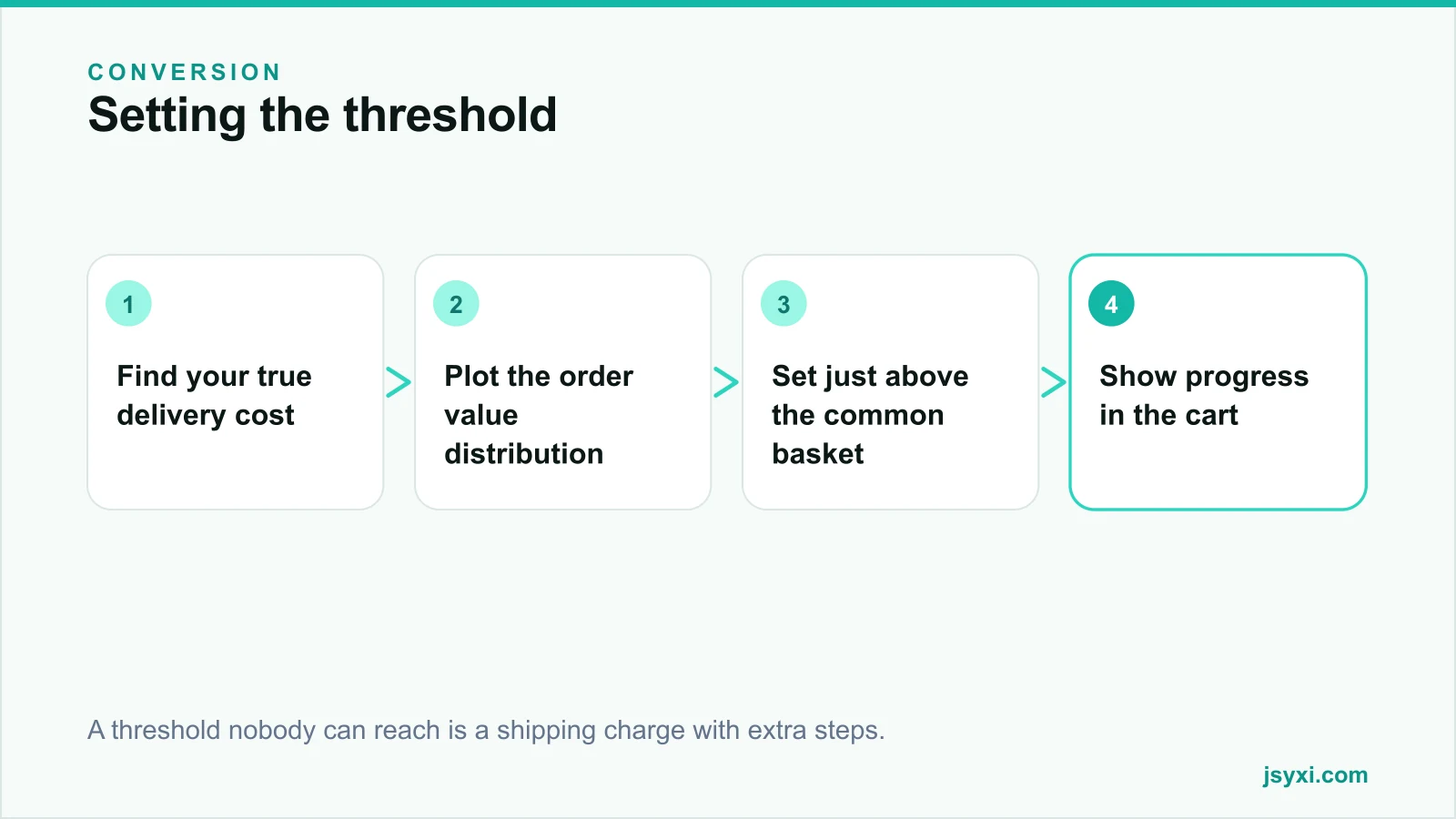
Step 3: Set the threshold just above the common basket
The threshold should be reachable by adding one more reasonable item - not by doubling the order.
A practical starting point is roughly 15 to 30 per cent above the median order value, adjusted for your catalogue:
- If most orders are one item at Rs 800, a Rs 999 threshold is reachable with a small add-on
- A Rs 2,000 threshold in the same store is a shipping charge with extra steps
- If your cheapest add-on is Rs 400, do not set the gap smaller than that - the customer needs something to add
Check the margin arithmetic: at the threshold, does the gross margin cover the delivery cost you calculated in step 1? If not, the threshold is too low regardless of how good it looks.
Step 4: Show progress, not just the rule
A threshold nobody sees does nothing. Communicate it at three points:
- In the announcement bar - "Free delivery over Rs 999" using an announcement bar
- On the product page - how much more is needed for this item to qualify
- In the cart - a live progress line: "Add Rs 220 more for free delivery"
The cart progress line is the one that changes behaviour. It converts an abstract rule into a specific, small, achievable action.
Make the remaining amount specific and update it live as the cart changes. And when the threshold is met, say so clearly - the confirmation is part of the reward.
Step 5: Suggest what to add
A progress line that says "add Rs 220 more" and shows nothing to add wastes the moment. Pair it with two or three genuinely relevant items in that price range - consumables, accessories, or refills.
Do not suggest an item that costs less than the gap; the customer will add it, miss the threshold, and feel misled.
Step 6: Measure the right outcomes
A threshold can lift average order value and still lose money. Track together:
- Average order value, before and after
- Conversion rate, before and after
- Gross margin per order, after delivery cost
- Share of orders just below and just above the threshold
- Return rate on threshold-driven add-ons
The failure mode to watch for: average order value rises, conversion falls slightly, and margin per order falls because the add-ons are low-margin items that also get returned. That is a worse business than before.
Step 7: Consider the alternatives
A single global threshold is not the only option:
- Zone-based thresholds, if your delivery cost varies sharply by region
- Category thresholds, if weight varies wildly across the catalogue
- Free delivery for members, as a loyalty benefit rather than a universal cost
- Flat low-cost delivery, which is often more honest and easier to communicate than a threshold nobody reaches
If your true delivery cost is high and your margins are thin, a clearly stated flat charge with an accurate delivery date can outperform a free-shipping promise the customer cannot access.
Common mistakes to avoid
- Copying a competitor's number. Their costs, margins, and basket sizes are not yours.
- Setting the threshold from the mean. Use the distribution.
- Hiding the rule until checkout. The surprise is the abandonment - see reducing cart abandonment.
- No progress indicator. The rule only works when the gap is visible and small.
- Never revisiting it. Courier rates and basket sizes change; review quarterly.
Frequently asked questions
What is a good free shipping threshold?
One that sits roughly 15 to 30 per cent above your median order value and is reachable by adding one ordinary item. There is no universal number - it depends on your basket distribution and your true delivery cost.
Should the threshold be based on the average order value?
No. Use the median and the shape of the distribution. Averages are pulled up by a small number of large orders and produce thresholds most customers cannot reach.
Does free shipping increase conversion?
Usually, when the threshold is reachable and clearly communicated. An unreachable threshold behaves like a shipping charge and can reduce conversion while adding confusion.
Should I show shipping cost on the product page?
Yes. Delivery cost discovered late is one of the largest causes of abandonment. Show the cost, or the threshold and the gap, before the customer reaches the cart.
Next steps
Calculate your true delivery cost per successful order including returns, plot your order value distribution, and set a threshold one ordinary add-on above the common basket. Then show the gap live in the cart and measure margin, not just order value.
Start free and put an honest delivery promise in front of every buyer.