
Ideas for better growth
Measuring Your Site Without Third-Party Cookies
Chris Content · · 5 min read

Third-party tracking keeps shrinking. How to keep measuring what matters using first-party data, server-side events, and metrics that survive consent choices.
Cross-site tracking has been narrowing for years: browser restrictions, platform privacy changes, consent requirements, and ad blockers all reduce what third-party tools can see. Teams that built their reporting on that foundation are watching their numbers degrade and calling it a data problem.
It is not a data problem. It is a dependency problem. The measurement that survives is the measurement you own.
What actually changed
- Third-party cookies are restricted or blocked by default in most browsers
- Storage lifetimes for scripted first-party cookies are limited in some browsers
- Consent requirements mean a share of visitors are never measured at all
- Ad blockers remove common analytics and advertising scripts entirely
- Platform-reported conversions increasingly rely on modelling rather than observation
The practical consequence: your analytics undercounts, your platform-reported conversions overcount, and the two will never reconcile. Stop trying to make them agree.
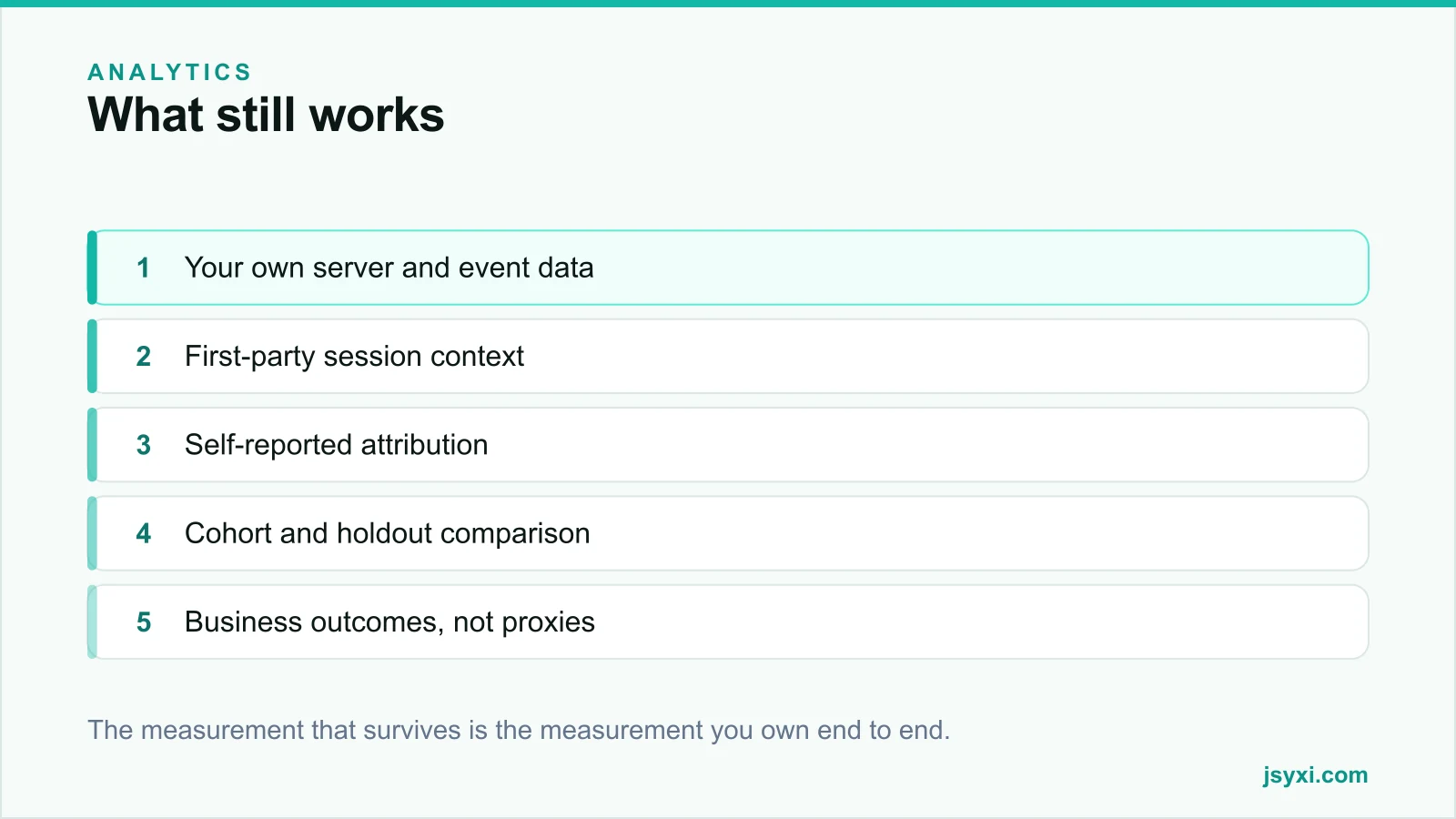
Start from your own systems
Your most reliable data is not in an analytics tool at all:
- Orders, revenue, and margin from your commerce platform
- Enquiries and their outcomes from your CRM
- Support contacts by topic
- Returns and refunds
- Repeat purchase rate and customer lifetime value
None of this depends on a browser cookie. It is complete, it is yours, and it describes the outcomes you actually care about. Start every report here and work outwards.
Capture context at the source
The one thing your commerce and CRM systems lack is where the customer came from. Capture that yourself, at the moment of submission:
- First-touch source stored in a first-party context on the visitor's first session
- Campaign parameters preserved through navigation
- Source page recorded on every form submission
- Calculator or configurator inputs attached to the enquiry
That gives you attribution inside your own systems rather than inside a vendor's. Our guide on wiring your website into your CRM covers the implementation, and consent still applies - see our privacy guide.
Ask people directly
Self-reported attribution is underrated. A single optional question at checkout or on an enquiry form - "How did you hear about us?" - captures channels no tracker sees: word of mouth, a podcast, a shop sign, a friend's recommendation.
- Keep it optional and to one question
- Offer a short list plus a free-text option
- Compare it against your tracked data; the gaps are informative
- Do not use it as your only source, and do not expect precision
At small volumes it is often more useful than a tracking report, because it captures the offline half of the journey.
Move measurement server-side where it matters
For your most important events - purchases, qualified enquiries - recording them on your server is more reliable than recording them in a browser:
- Not blocked by extensions
- Not lost to script failures
- Not dependent on the page staying open
- Still subject to consent obligations, which you must honour
Server-side measurement is not a way around consent. It is a way to make consented measurement reliable.
Use methods that do not need individual tracking
When you cannot follow individuals, compare groups:
- Holdout tests. Withhold a campaign from one region or segment and compare outcomes.
- Geographic splits. Run a channel in some areas and not others.
- Before and after with a control. Compare against a segment that did not receive the change.
- Cohort analysis. Group customers by acquisition month and follow them forward.
These answer the question that matters - did this spend produce revenue - without needing to identify anyone.
Pick metrics that survive
Prefer:
- Revenue, margin, and order count from your own systems
- Qualified enquiries and their conversion rate
- Repeat purchase rate and customer lifetime value
- Self-reported source distribution
- Landing page performance from server logs
Treat as directional only:
- Session counts and user counts
- Last-click channel attribution
- Platform-reported conversions
- Any funnel that spans multiple domains
Set expectations internally
The hardest part is organisational. Explain, in advance:
- Analytics undercounts; platforms overcount; neither is lying
- The gap will not close, and reconciling them is wasted effort
- Trends matter more than absolute numbers
- Your commerce and CRM totals are the source of truth for revenue
A team that understands this stops chasing discrepancies and starts making decisions.
Common mistakes to avoid
- Treating platform-reported conversions as observed fact. Much of it is modelled.
- Ignoring consent to preserve numbers. The regulatory and reputational cost is far higher than the reporting benefit.
- Adding more tracking tools. More scripts, same blind spots, slower site.
- Reporting sessions as the headline metric. Report revenue and qualified enquiries.
- Never reconciling against your own systems. Your order table is the truth.
Frequently asked questions
Is web analytics still accurate without third-party cookies?
Not for cross-site tracking or precise individual journeys. It remains useful for on-site behaviour and trends. For revenue and enquiry outcomes, use your own commerce and CRM data as the source of truth.
What is first-party analytics?
Measurement based on data you collect and store yourself - your server logs, your own event records, and context captured at submission - rather than data collected by a third party across many sites.
Does server-side tracking avoid consent requirements?
No. Consent obligations follow the personal data, not the technical method. Server-side measurement makes consented tracking more reliable; it does not remove the obligation.
Why do my analytics and ad platform numbers never match?
They measure differently, attribute differently, and one of them models conversions it cannot observe. The gap is expected. Use your own order and enquiry data as the reference and treat both platforms as directional.
Next steps
Build one report from your own order and enquiry data, add a "how did you hear about us" question, and capture first-touch source on every submission. Then stop trying to reconcile the platforms.
Start free and use a visitor counter backed by your own first-party data rather than an invented number.