Ideas for better growth
Building an Abandoned Cart Email Sequence
Chris Content · · 5 min read
What to send, when to send it, and what to say. A three-message recovery sequence that leads with help rather than discounts, plus the consent rules that apply.
Cart recovery is one of the few marketing programmes with an obvious audience: people who chose a product, entered their details, and stopped. They are not strangers.
Most sequences waste that by opening with a discount, which trains customers to abandon on purpose and gives away margin to people who would have returned anyway.
Fix the structural problems first
Before building a sequence, remember that recovery is treating a symptom. If your abandonment is caused by a late shipping charge or a broken payment retry, an email will not fix it - see reducing cart abandonment without discounts.
Recovery is worth doing once the checkout itself is sound.
Get consent right
You need a lawful basis to email someone who did not complete a purchase:
- Capture the email address early in checkout, and be clear it will be used to contact them about the order
- Keep transactional recovery separate from marketing consent
- Include an unsubscribe route in every message
- Do not add abandoners to your general marketing list without explicit consent
- Keep a record of when and how consent was given
Our privacy compliance guide covers the wider obligations.
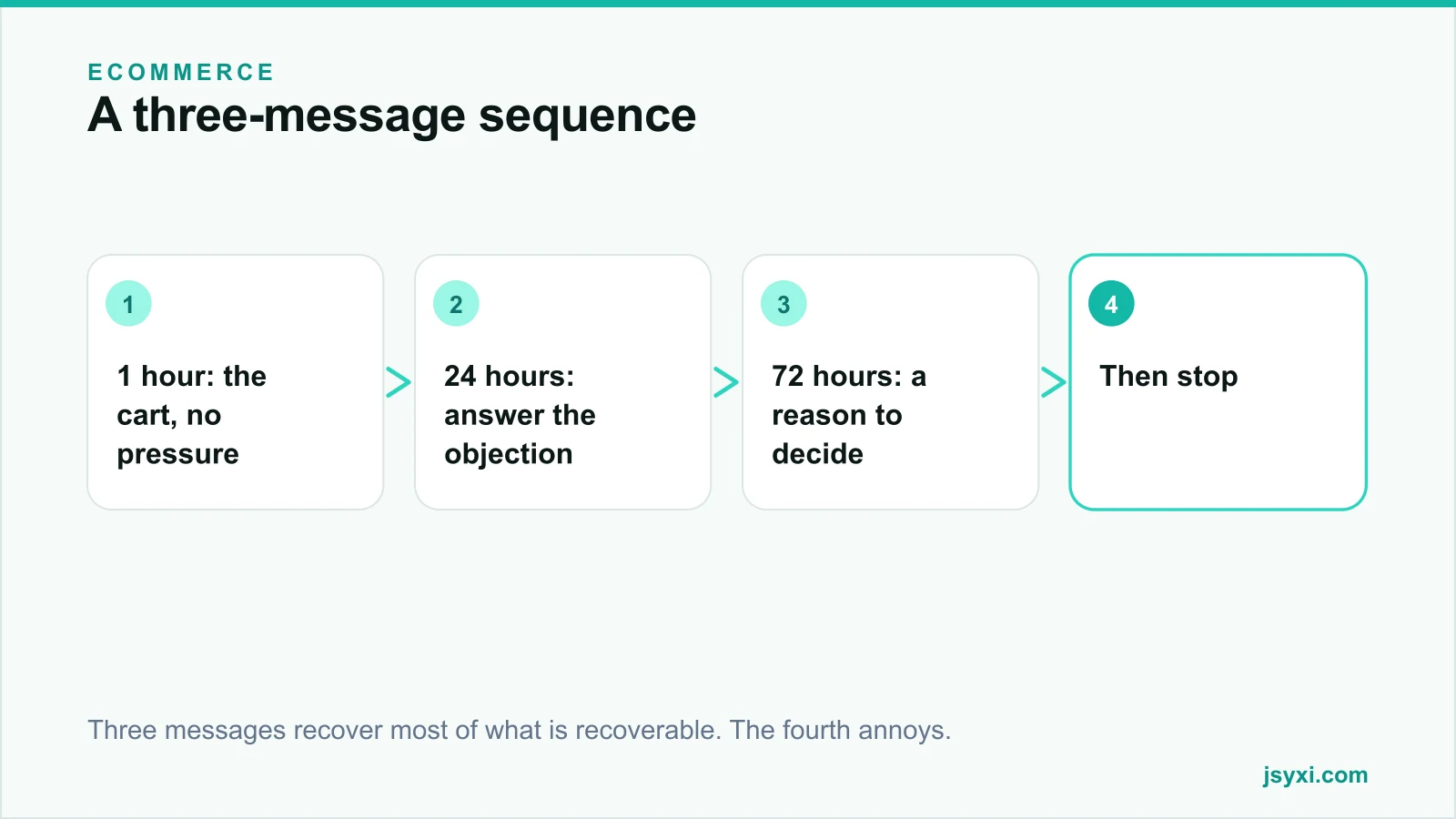
Message 1: about one hour later
Purpose: remove friction, assume nothing went wrong.
- Subject line that states the fact: "Your cart is saved"
- Show the items with images, variant, and price
- One button that returns them to the exact cart, not the homepage
- Restate delivery cost and estimated date
- One line of reassurance: return window, or a support route
- No discount, no urgency, no pressure
A large share of recoveries come from this message alone, because most abandonment is interruption, not rejection.
Message 2: about 24 hours later
Purpose: answer the objection that stopped them.
- Lead with the most common reason people hesitate on that product
- Sizing or compatibility guidance, if that is your category
- Delivery detail, if that is your usual objection
- A relevant review from a customer with the same use case
- An offer to answer one question on WhatsApp or by reply
Personalise by cart contents where you can. A message about fit for a clothing cart and about compatibility for an electronics cart will outperform one generic message for both.
Message 3: about 72 hours later
Purpose: give a reason to decide now, honestly.
Only at this point consider an incentive, and only if margin supports it:
- A genuine, time-limited offer with real terms
- Or free delivery, which often outperforms a percentage discount
- Or simply a stock note, if the item is genuinely low
- Never a countdown that restarts, and never invented scarcity - see honest urgency
Then stop. A fourth and fifth message recover very little and generate unsubscribes and spam complaints that cost you the rest of the list.
Write for the phone
- Subject line under about 45 characters, so it is not truncated
- Preview text that adds information rather than repeating the subject
- Single-column layout
- One primary button, large enough for a thumb
- Alt text on every image, since many clients block images by default
- Plain-text fallback that still contains the cart link
Segment where it matters
Not every abandoner deserves the same sequence:
- First-time versus returning customers - returning buyers rarely need reassurance, only a reminder
- Cart value - a high-value cart may justify a personal message or a call
- Stage reached - someone who reached payment and failed needs a different message from someone who left at the cart
- Payment failure - this is not abandonment. Say what happened and offer a retry with another method
Payment-failure recovery is often the highest-return segment and the most commonly missed.
Measure honestly
- Open, click, and recovery rate per message
- Revenue recovered, net of any discount given
- Unsubscribe and complaint rate, which caps how aggressive you can be
- Incremental recovery: hold back a small control group that receives nothing, and compare
Without a holdout you will credit the sequence for customers who were always coming back. That is the number most cart-recovery reporting gets wrong.
Add a non-email route
Not everyone gives an email address, and not everyone reads it:
- An on-site reminder when they return, showing the saved cart
- A WhatsApp follow-up where you have consent
- A browser notification, only with explicit permission
Keep the total number of contacts across all channels within the same limit. Three messages means three, not three per channel.
Common mistakes to avoid
- Opening with a discount. It trains deliberate abandonment.
- Linking to the homepage. The cart must be one tap away.
- Six-message sequences. They generate complaints, not revenue.
- Treating payment failure as abandonment. It needs a different message.
- No holdout group. You will overstate the programme's value.
Frequently asked questions
When should the first abandoned cart email be sent?
About an hour after abandonment, while the intent is still warm and the decision is fresh. Sending within minutes can feel intrusive; waiting a day loses the easiest recoveries.
How many abandoned cart emails should I send?
Three. A reminder, an objection-handling message, and a final one with a reason to decide. Beyond three, recovery drops sharply and unsubscribes rise.
Should abandoned cart emails include a discount?
Not in the first message. Lead with the cart and the delivery promise, then answer the likely objection. Reserve any incentive for the final message, and only if your margin supports it.
Do I need consent to send cart recovery emails?
You need a lawful basis. Capture the address in checkout with a clear statement of how it will be used, keep recovery separate from general marketing consent, and include an unsubscribe route in every message.
Next steps
Build the three-message sequence with a holdout group so you can measure real incremental revenue, and separate payment-failure recovery into its own message.
Start free and make sure the cart link goes straight back to the cart.