
Connecting Quote Requests to a Custom CRM for a B2B Manufacturer
Illustrative case study: how a B2B manufacturer could turn incomplete website quote requests into a traceable, secure CRM workflow for sales and engineering.
By jsyxiPublished
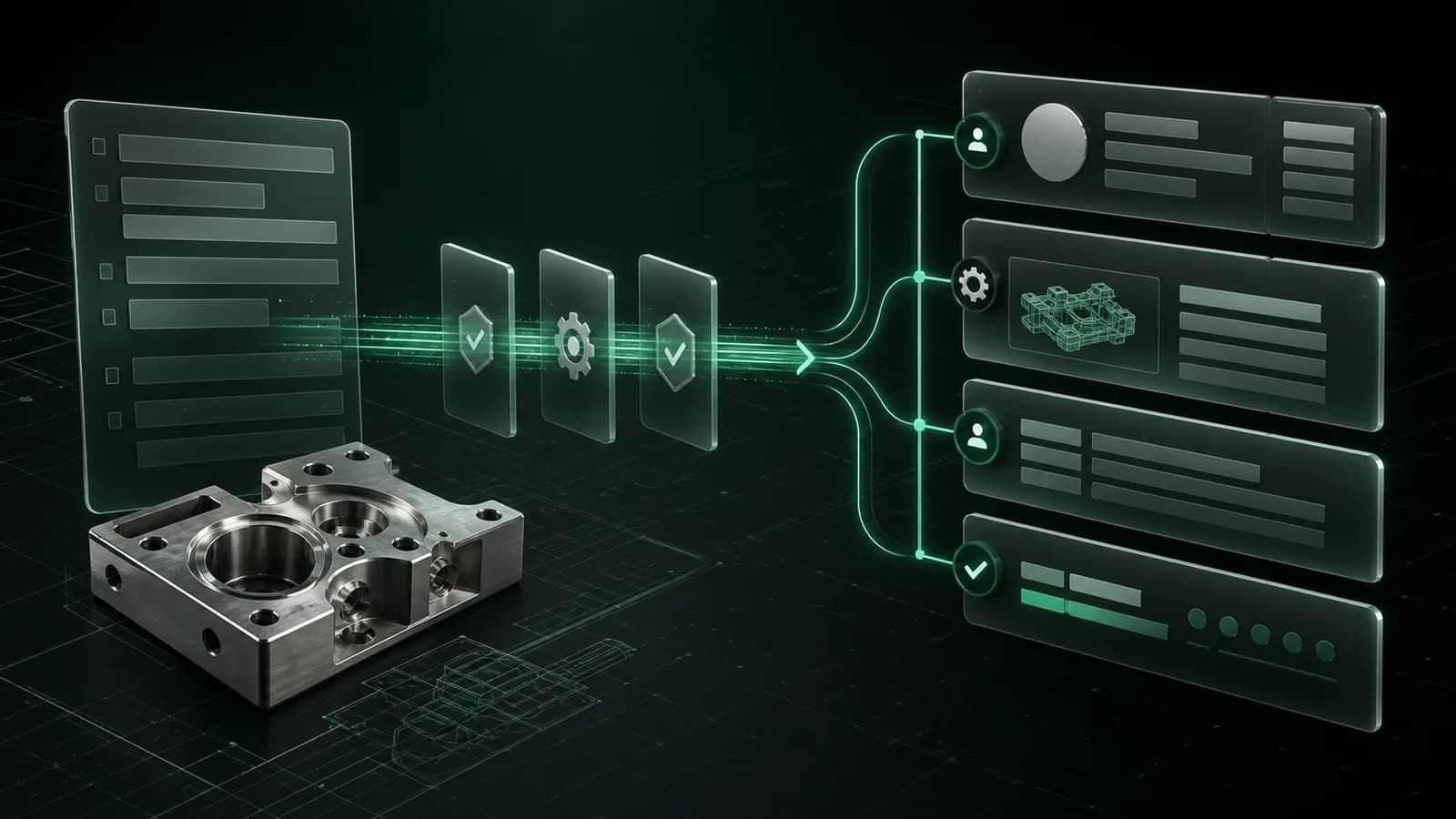
Illustrative case study: This is a representative scenario created to explain a possible delivery approach. It is not a named customer claim, testimonial, or guaranteed result.
Context
Consider a mid-sized manufacturer that sells configurable components to distributors, contractors, and direct business buyers. Its website attracts useful enquiries, but the request-a-quote form asks only for a name, phone number, and message. Sales staff receive submissions by email, then copy details into spreadsheets while asking follow-up questions about product family, application, quantity, delivery location, drawings, and required date.
The problem is not simply an old form. The website, inbox, spreadsheet, and sales process each describe the enquiry differently. Important attachments can become separated from the conversation. Two team members may respond to the same request, while a technically complex opportunity can wait because nobody knows that engineering input is required.
The representative brief is to connect the public quote journey to a custom CRM workflow without pretending that software can produce an accurate quotation before a person validates the specification.
The challenge
The workflow has to serve two audiences. Buyers need a short, understandable route that does not demand internal manufacturing terminology. Sales and engineering need enough structure to assess fit, ownership, urgency, and the next action.
A discovery review would normally identify questions such as:
- Which fields are required for every product family, and which are conditional?
- Can a distributor request on behalf of an end customer without exposing confidential information?
- Which files are accepted, how are they scanned, and who can open them?
- What makes a request ready for commercial review rather than technical review?
- Which CRM record owns later emails, notes, tasks, and revisions?
- What happens if the CRM or file service is temporarily unavailable?
Starting with those decisions prevents a polished form from feeding an unreliable process.
Strategy
The proposed strategy uses one enquiry record as the source of truth. The website collects a sensible first layer of information, the integration validates and enriches it, and the CRM coordinates human work.
The public journey would use progressive disclosure. A buyer first selects the broad request type and product family. Relevant questions then appear for dimensions, materials, operating conditions, quantities, location, and timing. An open notes field remains available because real manufacturing requirements do not always fit a predefined list.
Every submission receives a unique reference generated by the server. Repeated delivery of the same request should update or safely ignore the existing record rather than create duplicate opportunities. Routing rules can assign an owner by territory, product line, account relationship, or technical-review need, but a visible queue must catch anything the rules cannot classify.
Implementation approach
The first deliverable would be a shared data dictionary: field name, purpose, allowed values, owner, privacy level, and CRM destination. This small artefact keeps the form, integration, reports, and sales language aligned.
Implementation could then proceed in stages:
- Map the current enquiry and quotation process with sales, engineering, and operations.
- Build a responsive quote form with conditional questions, clear file rules, and accessible validation. A lightweight form tool can prove the content and interaction before deeper integration.
- Add a server-side intake endpoint that validates submissions, assigns a reference, scans attachments through the approved file workflow, and records delivery attempts.
- Create or match the organisation and contact, then create a dedicated quote-request record in the CRM.
- Apply routing rules, task ownership, status history, and notifications without automatically setting a commercial price.
- Send the buyer a confirmation that repeats the submitted scope, reference, expected next step, and a safe way to add information.
- Provide an exception queue for unmatched accounts, failed files, integration errors, and requests that need manual classification.
The team should test the normal path and awkward cases: duplicate clicks, very large drawings, unsupported formats, missing fields, an existing customer using a different email address, and an integration outage.
Measurement plan
Success should be assessed against a documented baseline rather than a dramatic headline. Useful operational signals include:
- the share of requests complete enough for the first review;
- time between submission and clear ownership;
- duplicate records and manual copy-and-paste steps;
- requests waiting without a next action;
- reasons that opportunities are disqualified or returned for more detail;
- file-processing failures and integration retries;
- feedback from buyers who could not describe their requirement in the form.
The team should segment findings by request type and product family. A simple reorder enquiry and a new engineered application should not be judged by the same cycle.
Guardrails
Manufacturing enquiries can contain commercially sensitive drawings and personal data. Access should follow least privilege, attachments should use approved storage and scanning, and retention rules should be agreed before launch. Logs must help diagnose delivery without copying confidential content unnecessarily.
Automation should never imply that a submission is feasible, compliant, or priced. Technical and commercial approvals remain explicit human steps. The interface should also state what the manufacturer can safely evaluate online and direct unsuitable disclosures to an appropriate channel.
Definition of success
This scenario would be considered successful when:
- buyers receive a clear reference and know what happens next;
- staff work from one traceable enquiry record rather than disconnected copies;
- ownership, status, and exceptions are visible;
- technical review occurs when required, before a quote is promised;
- failures can be retried or handled manually without losing the request;
- the process remains usable on mobile and understandable without factory jargon.
Teams planning a similar workflow can review the software development service, read the embed and installation guidance, or book a consultation to map the data and ownership model before implementation.
Could this approach fit your business?
Start free, or book a consultation to turn the most relevant ideas into a practical plan.