
Ideas for better growth
A Blog Content Strategy for Online Stores
Chris Content · · 5 min read

Most store blogs publish for the sake of publishing. How to choose topics that support buying decisions, structure articles to convert, and measure what pays.
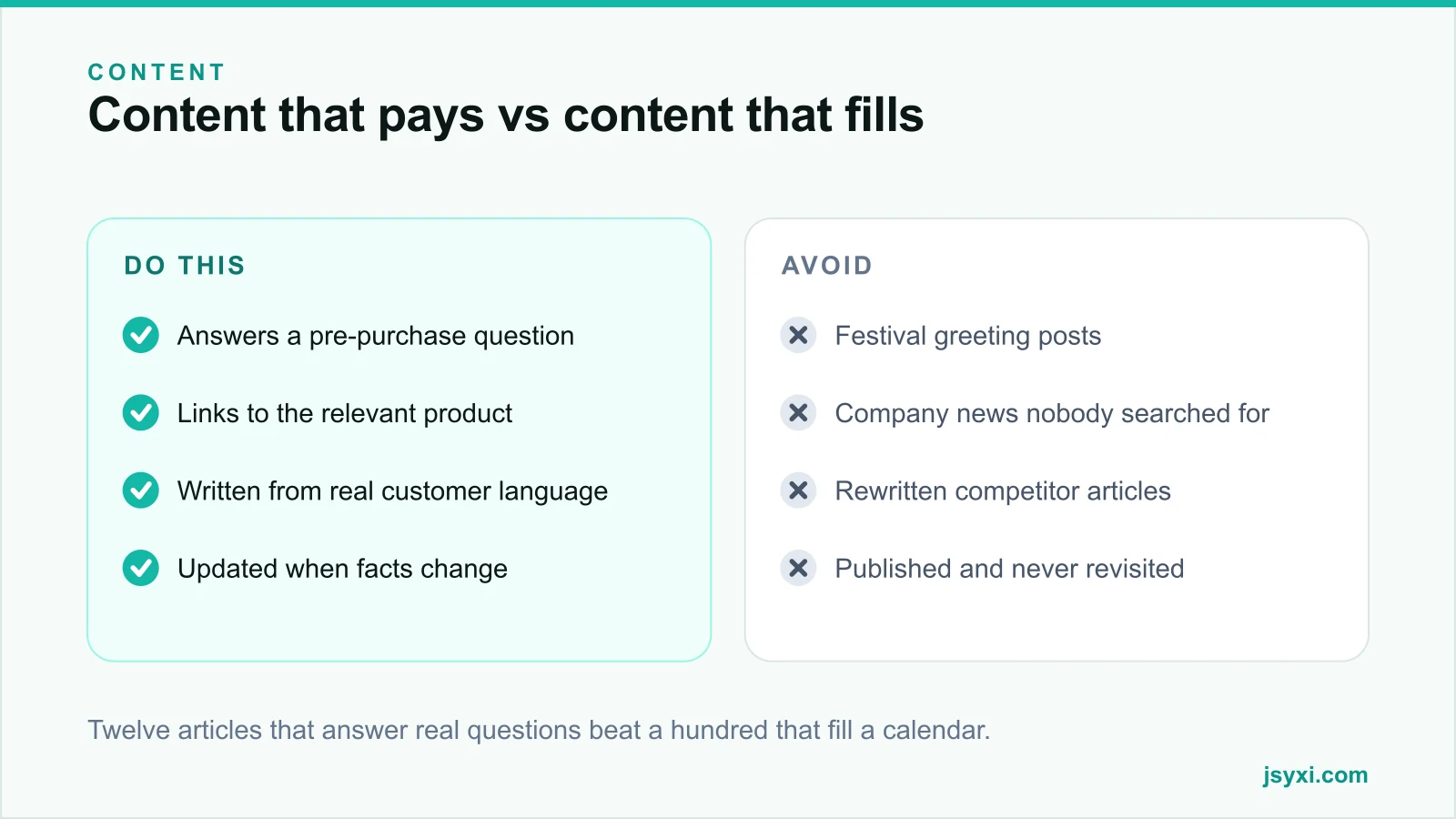
Most store blogs exist because someone said stores should have a blog. They publish festival greetings, company news, and generic listicles, and then conclude that content marketing does not work.
Content works for stores when it answers the questions people ask before buying. That is a much smaller, much more useful set of topics.
Decide what the blog is for
Pick one primary job:
- Capture pre-purchase searches you cannot rank for with product pages
- Answer objections so product pages stay short and sales conversations get shorter
- Support the category by covering the surrounding decisions
- Retain customers with care, usage, and troubleshooting content
For most stores the first two matter most. Company news and festival posts serve none of them, and should be social posts if they exist at all.
Find the topics from real questions
Your topic list should come from evidence, not brainstorming:
- Support inbox and chat transcripts
- Pre-purchase questions your sales team answers repeatedly
- Site search terms that returned nothing
- Review text where customers explain what they were unsure about
- Search Console queries you appear for but do not properly answer
Each recurring question is a candidate article. Sort by frequency and by how close the question sits to a purchase.
Cover the decision, not the category
The highest-value articles for a store sit close to the purchase:
- Buying guides - how to choose between the options you sell
- Sizing, fit, and compatibility - the questions that cause returns
- Care and maintenance - which reduce returns and support contacts
- Comparisons - honest ones, including when a cheaper option is right
- Use-case guides - "what to buy for a first apartment", "what a small bakery needs"
Notice these all end naturally in a product recommendation, which is what makes them worth writing.
Structure each article to be useful and findable
- Answer the question in the first two paragraphs. Do not make readers scroll past a history of the industry.
- Use descriptive H2 headings that match how people phrase the sub-questions.
- Keep paragraphs short and use lists where the content is genuinely a list.
- Include one useful image or diagram with descriptive alt text.
- Add an FAQ section with the related questions, using an FAQ accordion where it suits the page.
- Link to the relevant products and categories in context, not only in a banner at the end.
Link the blog into the store
An article that does not connect to anything you sell is a cost. Connect it:
- Contextual links to the specific products discussed
- A link to the category hub
- Links to related articles, so a reader can go deeper - see our internal linking guide
- A relevant offer, if you have one, placed after the answer rather than before it
Publish less, maintain more
A store blog with twelve well-maintained articles outperforms one with two hundred abandoned posts. Maintenance is where the compounding happens:
- Review the top ten articles every quarter
- Update prices, product links, and any factual claims
- Add newly common questions to the FAQ section
- Remove or merge articles that overlap and compete
- Refresh the publish date only when the content genuinely changed
Merging two mediocre articles on the same topic into one strong page is usually the highest-return content work available.
Measure what actually pays
Traffic is the wrong headline metric. Track per article:
- Assisted conversions - sessions that read the article and later ordered
- Product page visits originating from the article
- Search queries the article ranks for, and whether it answers them
- Support contacts on the covered topic, before and after
- Return rate, for sizing and compatibility articles
An article that reduces returns on a high-return product is worth more than one that brings ten times the traffic and sells nothing.
A realistic cadence
For most small stores, one thorough article every two weeks beats two thin ones a week. Quality and maintenance matter far more than frequency. If choosing between publishing something new and improving something that already ranks, improve the existing page.
Common mistakes to avoid
- Publishing on a calendar rather than on evidence.
- Generic listicles that any competitor could have written.
- No links to products. The article has no commercial path.
- Never updating. Stale prices and dead product links destroy trust.
- Copying competitors. You inherit their mistakes and rank behind them.
Frequently asked questions
How often should an online store publish blog posts?
Quality beats frequency. One well-researched article every two weeks, kept updated, outperforms several thin posts a week. If you must choose, improve an existing article that already ranks.
What should an ecommerce blog write about?
The questions customers ask before buying: how to choose, how to size, how to care for the product, and honest comparisons. Company news and festival greetings belong on social, not on a blog meant to earn search traffic.
Do blog posts help ecommerce SEO?
They can, by ranking for informational and commercial queries that product pages cannot serve, and by supporting category pages through internal links. Thin, unmaintained posts do not help and can dilute your site.
How long should ecommerce blog posts be?
Long enough to fully answer the question and no longer. A sizing guide might be 600 words; a buying guide covering six options might be 2,000. Padding to hit a word count makes the page worse.
Next steps
List the ten questions your support and sales teams answer most often before a purchase. Write the top three properly, link them to the relevant products, and set a quarterly reminder to update them.
Start free and add an FAQ widget to the articles you publish.